
Lessons from Canada's Wartime Industrial Mobilization
Nov 12, 2026Canada's industrial success during the Second World War is often remembered through iconic images: shipyards operating around the clock, aircraft rolling off assembly lines, and factories rapidly converting civilian production into military output. It is a remarkable chapter in our history, and one that continues to shape how we think about manufacturing, innovation, and national resilience.
The country's wartime production miracle was not simply the result of factories working harder. It came through a deliberate effort to identify, map, and coordinate manufacturing capabilities across the nation. Canada recognized that understanding what companies could build was every bit as important as understanding what they already built.
With rising geopolitical uncertainty, supply chain disruptions, and growing demands for economic and defence resilience, Canada must urgently gain visibility into our critical industrial sectors.
The First Challenge was Visibility
When the Second World War began, Canada had a diverse industrial base but no comprehensive picture of its collective manufacturing capabilities.
Under the leadership of C.D. Howe and the Department of Munitions and Supply, the federal government launched an unprecedented effort to catalogue industrial assets across the country. Officials worked alongside manufacturers to identify production facilities, machine tools, engineering expertise, workforce skills, transportation networks, and available production capacity.
The objective was to understand the full extent of Canada's productive potential.
Government and industry leaders needed answers to strikingly familiar questions:
- Which companies possess specialized manufacturing capabilities?
- Where is excess production capacity available?
- Which firms can quickly adapt to new requirements?
- How can we build robust domestic production and supply networks?
Looking Beyond What Companies Made
Perhaps the most important insight of Canada's wartime mobilization was that manufacturers should not be categorized solely by the products they produced.
A company known for bicycles, agricultural equipment, industrial machinery, or consumer goods might never have manufactured military equipment. Yet that same company might have expertise in machining, welding, casting, assembly, tooling, or precision fabrication that made it an ideal supplier for wartime production.
Rather than searching only for companies that already produced military equipment, planners focused on identifying capabilities that could unlock enormous productive potential.
Thousands of businesses were integrated into wartime supply chains because decision-makers understood the skills, equipment, and expertise that existed beneath the surface of their commercial activities. Small machine shops became critical suppliers. Automotive manufacturers shifted into military production. Companies from entirely unrelated sectors found new roles supporting national priorities.
The government's competitive advantage was not ownership of industrial assets. It was visibility into industrial capabilities.
A Familiar Challenge in a Different Era
Fast forward more than eighty years, and the strategic environment looks very different.
Today's manufacturers are navigating a rapidly changing world where supply chains have become more complex than ever, and sectors such as aerospace, defence, batteries, critical minerals, semiconductors, and autonomous systems are increasingly viewed through both economic and strategic lenses.
Canada is home to thousands of highly capable manufacturers, technology firms, and suppliers. Yet organizations often struggle to identify domestic sources of capability, qualified partners, alternative suppliers, or hidden capacity within the broader industrial ecosystem.
In many cases, the problem is not a lack of capability but rather a lack of visibility.
When a manufacturer needs a specialized component, when a defence contractor is looking for domestic suppliers, or when policymakers want to assess industrial readiness, locating the right capabilities can still be surprisingly difficult.
The Modern Evolution of Industrial Mapping
This is why industrial capability mapping is becoming an increasingly important tool for strengthening Canada's manufacturing ecosystem.
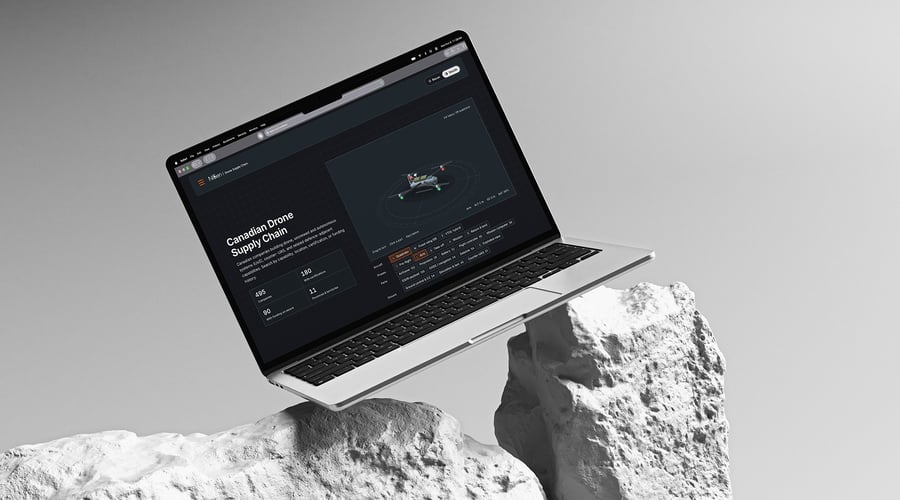
At NGen, the Drone Supply Chain Map was developed to provide greater visibility into Canada's drone and advanced manufacturing ecosystem. Rather than functioning as a simple directory, the platform helps identify suppliers, manufacturing expertise, production relationships, and capabilities across a rapidly growing sector.
The goal is similar to the one that guided Canada's wartime planners:
To better understand what core capabilities exist in Canada, where they are located, and how they can be connected to new opportunities.
For manufacturers, that means easier access to partners, customers, and suppliers.
For industry leaders, it means better visibility into ecosystem strengths and gaps.
For policymakers, it creates a clearer picture of domestic capacity in an increasingly strategic sector.
Explore Canada's Drone Supply Chain
Whether you're looking to understand the ecosystem, find potential suppliers, explore partnership opportunities, or assess Canada's manufacturing strengths in unmanned and autonomous systems, the Drone Supply Chain Map offers a powerful starting point.
Explore the tool: NGen Drone Supply Chain Map
As Canada's wartime planners understood more than eighty years ago, strategic advantage begins with knowing what capabilities exist. The better we understand our industrial strengths today, the better prepared we will be for the opportunities and challenges ahead.
Story by Robbie MacLeod, Senior Director, Communications & Member Services, Corporate Secretary, NGen